
In the United States, people often overlook their old coins, considering them insignificant, but this is a big mistake. Especially smaller coins like dimes and quarters can sometimes hide treasures worth millions of dollars. These coins are not just pieces of metal; each one holds a historical story, a technical error, or a rare minting process. Some specific American dimes from the mid-20th century and the 1976 Bicentennial quarters are considered among the most valuable collectibles in the world today.
Often, people simply consider their old coins as something to spend, but if you look closely, that same coin could offer you the opportunity to turn a small investment into a large profit.
How is the value of a coin determined?
The value of each coin is determined not by its appearance, but by the story behind it. First comes the mint mark, which indicates where the coin was made. In the United States, there are primarily three mints: San Francisco (S), Denver (D), and Philadelphia (P). Sometimes, the number of coins produced at a particular mint is very low, making them more valuable.
The second most important factor is the condition of the coin. If a coin has fewer scratches, clean edges, and retains its luster, its value increases significantly. In addition, errors during the minting process, such as double strikes, missing mint marks, or misplaced designs, make a coin extremely rare. Such coins are called error coins, and collectors buy them at very high prices.

The Significance of the 1946-S Roosevelt Dime

In 1946, after the death of Franklin D. Roosevelt, a new dime series was launched in his honor. The 1946-S Roosevelt dime, minted in San Francisco that same year, is considered a historical artifact today. In that era, the number of coins was limited, and many of them have worn down over time. Therefore, if someone possesses this coin in good condition, its value can reach thousands of dollars. The historical significance and limited availability make it even more special.
The 1968-S Roosevelt Dime and the World of Proof Coins
The 1968-S Roosevelt dime was part of a proof set made not for general circulation but for collectors. These coins have a mirror-like surface and every detail of the design is very clear. Some coins exhibit a slight doubling of the lettering, such as on the words “LIBERTY” or “IN GOD WE TRUST,” a phenomenon known as a double die. Such coins are extremely rare and can fetch several thousand dollars.
The 1975 “No S” Dime, a Startling Error
In 1975, a significant error occurred when some proof Roosevelt dimes were struck without the San Francisco “S” mintmark. To date, only two such coins have been confirmed. Due to their extreme rarity, these coins are considered among the rarest modern American coins. One such coin has sold for millions of dollars, proving that a small mistake can become a great treasure.
The 1916-D Mercury Dime, a Collector’s Favorite
The 1916-D Mercury dime is considered a star among American coins. It features a beautiful design and has a very low mintage number. Only a few hundred thousand were produced, making well-preserved specimens very rare today. This is why this coin can sell for over $100,000.

The Distinctive 1976 Bicentennial Quarter
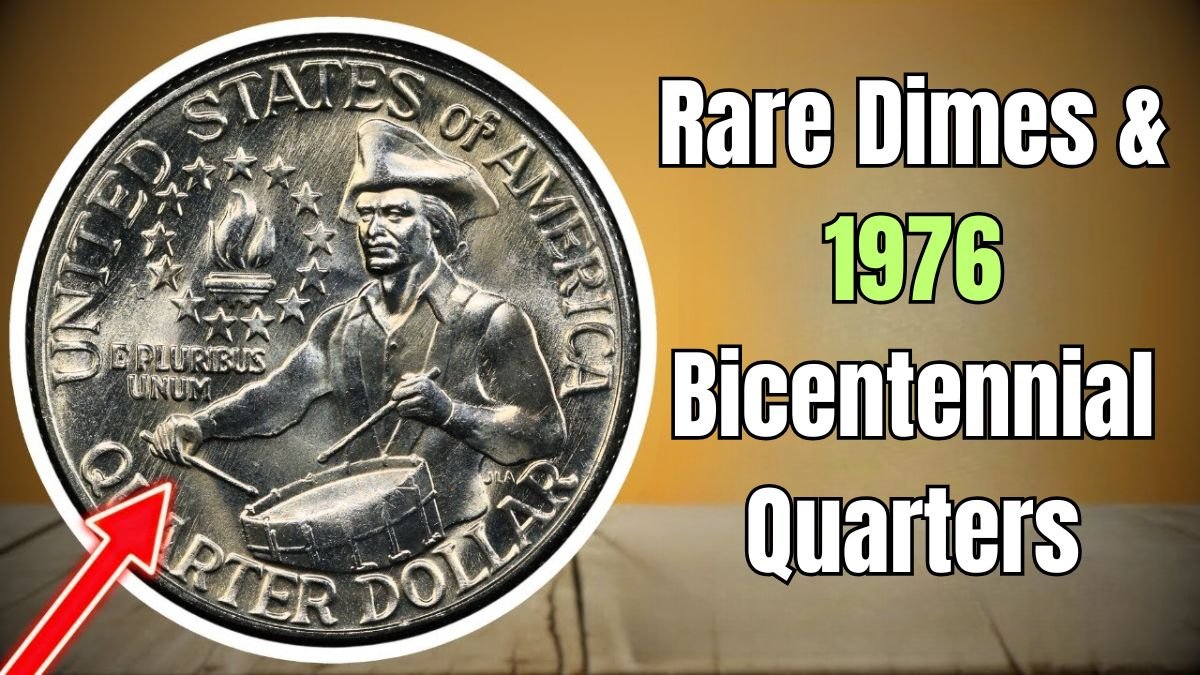
In 1976, a special quarter was issued to commemorate the 200th anniversary of American independence. It features a double date of 1776–1976 and a drummer boy on the reverse. These quarters are generally common, but some varieties, such as silver proof or error coins, can be very valuable. Some coins in perfect condition can fetch hundreds of thousands of dollars from collectors.
How to Identify Valuable Coins
If you want to examine your old coins, first pay attention to the mint mark. Then, look at the coin’s luster, edges, and design. If anything seems unusual, it could be an error. Silver coins can also be identified by their weight and sound. In case of any doubt, professional grading is the safest option.
Final Thoughts
Small coins like dimes and quarters are often overlooked, but with the right knowledge and a little investigation, these same coins can become a significant asset. Varieties like the 1946-S Roosevelt dime, the 1916-D Mercury dime, and the 1976 Bicentennial quarter prove that history and value are sometimes hidden right in our pockets.
FAQs
Q. Are all 1976 Bicentennial quarters valuable?
A. No, most are worth face value, but rare errors, silver versions, and high-grade coins can be worth much more.
Q. What makes a dime or quarter valuable?
A. Mintmarks, condition, rare errors, and historical importance play the biggest role in a coin’s value.
Q. How can I tell if my coin is silver?
A. Silver coins are heavier and make a high-pitched ringing sound when dropped compared to modern clad coins.
Q. Should I get my rare coin professionally graded?
A. Yes, grading by PCGS or NGC confirms authenticity and can greatly increase its market value.
Q. Can modern U.S. coins really be worth thousands or more?
A. Yes, certain modern coins with rare errors or missing mintmarks have sold for tens or even hundreds of thousands of dollars.
